BISMARCK — Before North Dakota’s child-protection system removes a child from a home, is it actually trying to keep that family together first? A federal audit put a number on that question, and the number isn’t good.
Not fully, but not nothing either. The state’s own federal audit found that in most of the cases where it applied, the state couldn’t show it had made a real effort to keep a family together before removing a child. It’s now under a corrective plan to try to fix that.
Key facts
- What: North Dakota’s Round 4 Child and Family Services Review found the state met the standard for trying to prevent removal before it happens in only 23% of applicable cases.
- Why it matters: The state was also not in substantial conformity with any of the seven federal outcomes or systemic factors reviewed.
- Who responded: ND HHS Public Affairs Officer Jennifer Skjod, on the record, addressing the CFSR findings, the improvement plan, removal standards, and service gaps.
Child Protective Services exists for a simple reason: sometimes the people who are supposed to protect a child are the ones putting that child in danger, and government has to step in. Nobody disputes that CPS needs the power to remove a child from a dangerous home. What’s harder to answer is whether that power is used only when it has to be, or whether removal sometimes happens before the state has really tried anything else.
North Dakota’s own federal review just answered a piece of that question, and it did it with a specific number.

How this kind of review actually works
Every few years, the federal government audits state child-welfare systems the way a school gives out report cards. Inspectors from the U.S. Department of Health and Human Services’ Children’s Bureau pull a sample of real cases (North Dakota’s review looked at 65: 40 foster care cases and 25 in-home cases) and grade specific things caseworkers did in each one: how often they visited parents, whether they tried to keep a family together before removing a child, whether kids saw their siblings, and so on.
Each of those specific things is called an “Item,” and each Item gets a score, the percentage of applicable cases that met the standard. The Items get grouped into 7 bigger “Outcomes” (things like “children are safe,” “children have stable placements”). Separately, the state’s actual systems, training, data-tracking, quality control, get graded on 7 “Systemic Factors.”
North Dakota didn’t pass any of the 7 Outcomes, and didn’t pass any of the 7 Systemic Factors. That’s the headline number, and it sounds like a state that failed everything. It’s more precise than that: some individual Items actually scored well (more on that below). It means enough of the overall report card came in low that the state didn’t pass, and it’s now required to file a formal Program Improvement Plan, essentially academic probation with federal oversight.
The one number that matters most
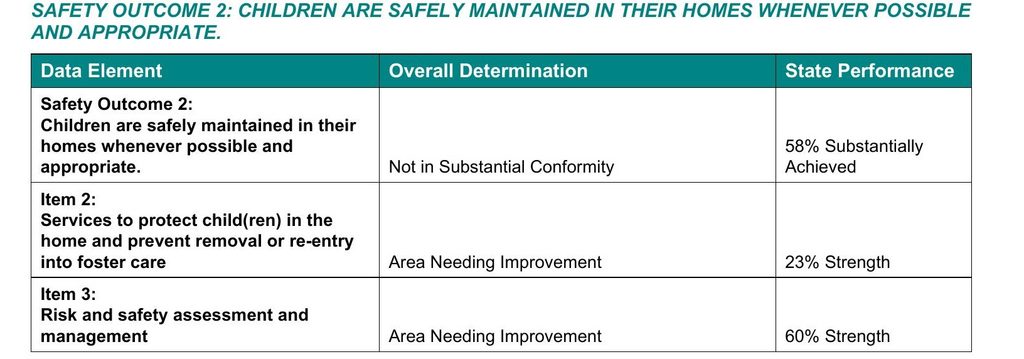
Of the 18 specific Items graded, one goes directly to the question at the center of this piece: did the state try to keep a family together before taking a child away?
That’s Item 2: “Services to protect children in the home and prevent removal.” In the cases where it applied, North Dakota met the standard only 23% of the time.
In the rest, the file showed one of two things: either the agency didn’t make a real, documented effort to provide the kind of services, counseling, in-home support, whatever the family actually needed, that could have kept a child safely at home, or the agency removed the child without providing those services first, regardless of whether removal turned out to be the right call. The review doesn’t say most of those removals were wrong. It says that in roughly three out of four applicable cases, the state couldn’t show its work on trying the alternative first.
That’s a different and more specific problem than “the state is bad at paperwork.” It’s the state’s own federal reviewer saying: we can’t confirm you tried to avoid this before you did it.
The rest of the findings, in context
A few other Items reinforce the same theme, that the system’s follow-through with parents specifically is inconsistent:
- Caseworker visits with parents and needs assessment/services to parents each met the standard in only 43% of applicable cases.
- Case plans developed jointly with parents couldn’t be confirmed as routine practice at all.
- Child and family involvement in case planning did better, 71%, but still fell short.
None of this proves any individual removal was wrong. It means the state’s own audit found a consistent pattern: engagement with parents, and effort to avoid removal, are the weakest parts of how the system operates.
It’s also not a wall of failure. Relative placement, whether a child who does need to leave home gets placed with family instead of strangers, was the standout strength, at 97%. That matters, and it’s worth saying plainly: this isn’t a system with no competence. It’s a system where trying to keep families together before removal is measurably weaker than almost everything else it does.
The review also found significant statewide gaps in mental-health care, substance-abuse treatment, and other services families are often asked to use to avoid removal or regain custody, citing wait lists, provider shortages, and transportation and housing barriers. That connects directly back to the 23% figure: if the services needed to keep a family together aren’t available or accessible, the caseworker can’t provide them, no matter how hard they try.
Read the documents
- North Dakota Child and Family Services Review, Round 4, Final Report (PDF)
- Browse all North Dakota CFSR Round 4 documents, including the state’s Statewide Assessment
- N.D.C.C. Chapter 27-20.3, Child Welfare (protective custody and shelter care)
- North Dakota HHS, Children and Family Services
- ND HHS Children and Family Services publications (Annual Progress and Services Reports)

The job nobody envies
None of this happens in a vacuum. Caseworkers operate inside an impossible bind on every case, usually with partial information and a clock running. Leave a child in a home and something happens, and the public asks why the state didn’t act. Remove a child too fast, without exhausting other options, and a family absorbs a trauma that may not have been necessary.
North Dakota HHS reported 467 confirmed cases of child abuse or neglect in 2024, down from 580 the year before, real children for whom intervention mattered. Nothing here argues for weakening CPS’s ability to act when a child is genuinely in danger. The question this review raises isn’t “should CPS exist.” It’s whether the system can show, case by case, that it tried the less drastic option first.
Confidentiality cuts both ways
Most government decisions become reviewable in public eventually: arrests generate records, charges get argued in open court, agency decisions can be challenged through public-records law. Child protection doesn’t work that way, for good reason, children shouldn’t have their worst moments turned into public spectacle. But that confidentiality makes the system harder to check from the outside, in the exact cases where the public most wants to know it got things right.
North Dakota doesn’t need to expose a single child’s file to answer questions about the system itself: What has to happen before a caseworker seeks removal instead of in-home services? Who signs off, and how fast? How often does the state check whether services were actually tried first? Those are policy questions, not privacy violations, and the state’s own review shows they’re worth asking.
What HHS says
North Dakota HHS Public Affairs Officer Jennifer Skjod responded to questions about the CFSR findings, the state’s Program Improvement Plan, emergency-removal standards, and the service gaps the review identified.
“The review was based on a relatively small sample of cases, which represents only a narrow portion of the work occurring across North Dakota.”
Jennifer Skjod, ND HHS Public Affairs Officer
Skjod said HHS “remain[s] committed to strengthening our practice” using the CFSR results “as one of several tools.” On the required Program Improvement Plan, she said it “has been approved by our federal partners.” North Dakota has opted into a Children’s Bureau pilot called “A Home for Every Child”, a national effort focused on reducing unnecessary foster-care entry and length of stay, increasing relative placements, and improving foster-provider recruitment and retention.
On emergency removals in general, Skjod said state law allows custody changes “only when a qualified authority, such as law enforcement, a juvenile court, or certain medical providers, determines that removal is necessary,” citing N.D.C.C. § 27-20.3, with any change then subject to judicial review.
On the service gaps, she said HHS’s Child and Family Services division works closely with the state’s Behavioral Health Division, and that local zones introduce new programs through staff training so caseworkers know what’s available where they work.
So, has trust been lost?
There’s no statewide poll settling this, and individual families’ frustrations aren’t proof either way. But North Dakota doesn’t have to guess: its own federal review found that in most applicable cases, the state couldn’t confirm it tried to keep a family together before removing a child.
Nobody is arguing for a weaker child-protection system. The argument is narrower: a system with the power to separate a parent from a child has to be able to show, consistently, that it tried everything short of that first. Right now, the strongest available evidence, a federal audit, not a hunch, says North Dakota can only show that in about one out of four cases where it applies.
Public trust in an agency this powerful isn’t granted because the mission is important. It’s earned by showing the harder option, removal, was the last resort, not the first one. That’s the standard North Dakota’s child-protection system should be measured against, and by its own numbers, it isn’t there yet.
What happens next
The Children’s Bureau’s CFSR data dashboard updates twice a year, in February and August. North Dakota’s next round of published performance data is due out in February 2027, the first real chance to see whether the state’s numbers, including Item 2, have moved.
Have information about this story? Email editor@701report.com.




Leave a Reply