
BISMARCK, N.D. — Halloween falls on a Saturday this year, and a social media campaign is urging people to use the costumes and crowds as cover to take down Flock cameras, a movement some are calling “De-Flock America.” Before you finalize your costume, here are three things worth knowing.
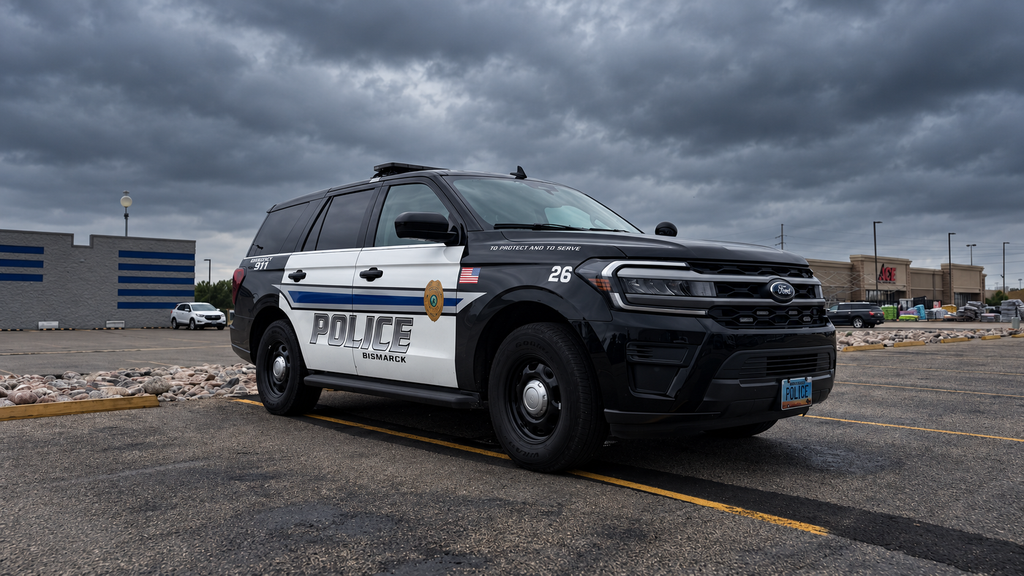
- THEY’RE NOT BPD’S CAMERAS
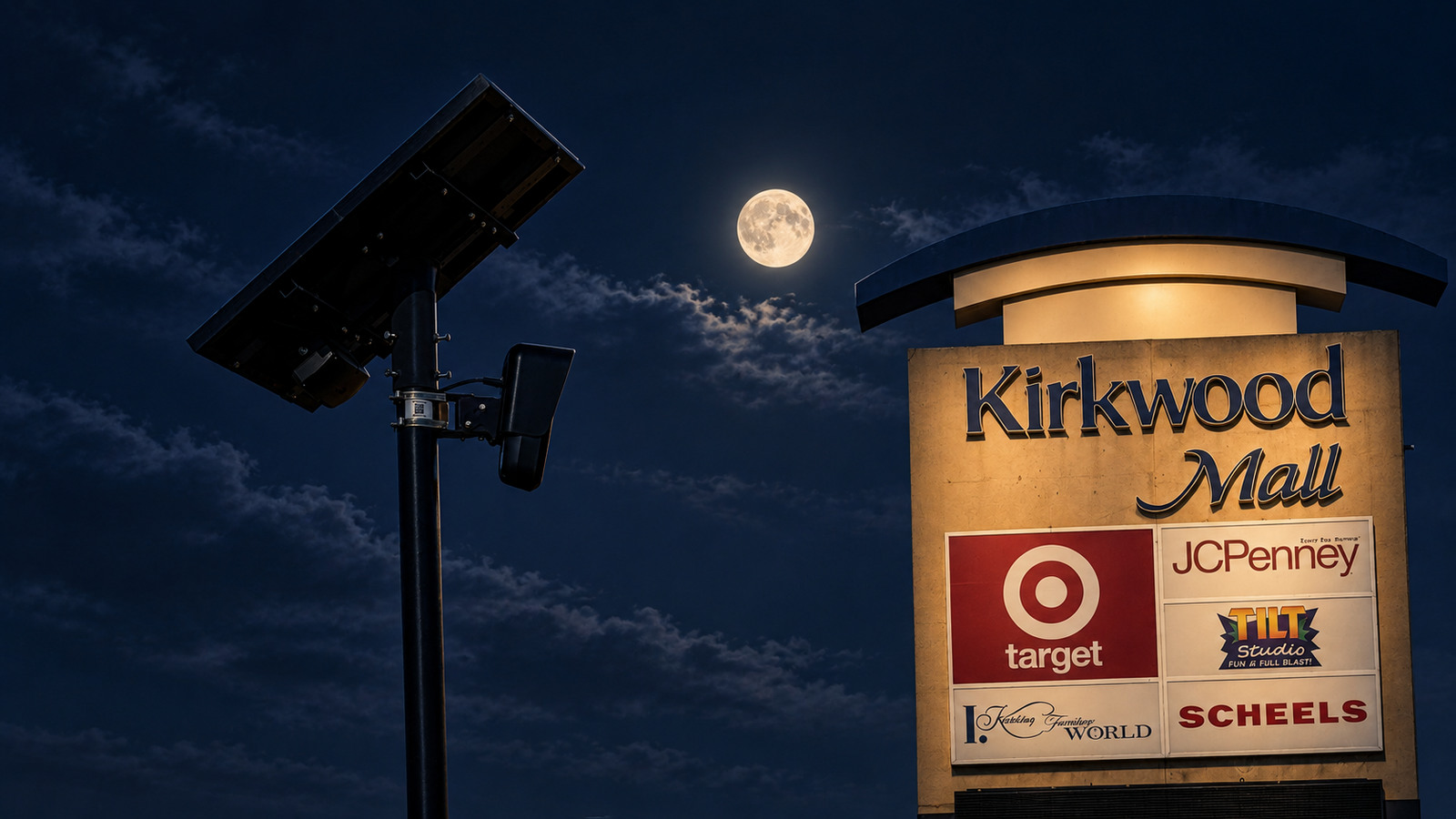
The Flock cameras 701 Report has identified in Bismarck are privately owned. The cameras around Kirkwood Mall belong to Scheels, according to Chief Jason Stugelmeyer. A separate set at Pinehurst Square, near Lowe’s, is one BPD says it has no access to; who owns them hasn’t been confirmed, and the property’s leasing agent did not respond to 701 Report’s email.
BPD pays nothing for its Flock access. So if the goal is to stick it to the police department, a downed camera doesn’t do that. The cost lands on the camera’s owner, or potentially Flock, depending on an agreement 701 Report hasn’t seen, not on BPD or city taxpayers.
It also carries real legal risk. Under N.D.C.C. § 12.1-21-05, intentionally causing more than $2,000 but no more than $10,000 in property loss is a Class C felony, and more than $10,000 is a Class B felony. Intentional damage from $100 through $2,000 is a Class A misdemeanor. Reports from other states put the replacement cost of a single camera between roughly $800 and $3,500, so one camera may or may not cross the felony line, but a cut pole or several cameras can. Elsewhere, a KCRG report published by Dakota News Now described a cut camera in Cedar Rapids, Iowa, and hundreds of license plate readers spray-painted in Savannah, Georgia. Security experts in that report warned the campaigns could lead to more arrests and said pressuring policymakers is a more effective way to protest.
- CHECK YOUR MAP BEFORE YOU PLAN YOUR ROUTE
If you spent early October plotting a path through the red dots on a Flock map, we have some news.
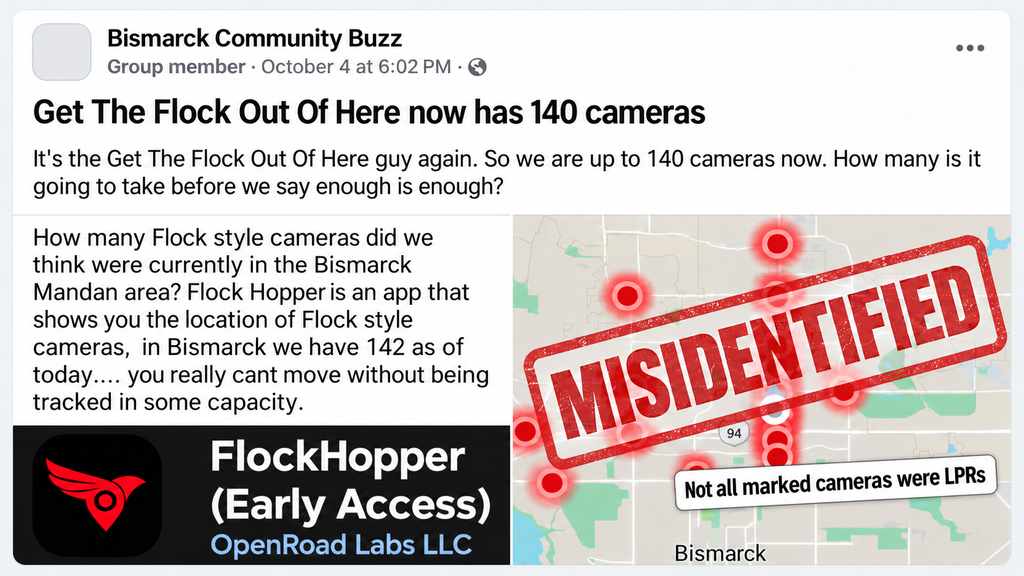
On Oct. 4, a post in a local Facebook group shared a screenshot from a smartphone app called FlockHopper listing 142 “Flock style” cameras in Bismarck. FlockHopper’s App Store listing says its map draws on the Deflock/OpenStreetMap database, a crowdsourced collection where volunteers submit camera locations. When 701 Report opened DeFlock that day, it showed a comparable listing, with entries labeled as Axon license plate readers. The entries 701 Report examined sat in places where ordinary intersection traffic cameras are installed.
Those entries no longer appear on DeFlock. 701 Report does not know whether they were removed by the people who submitted them or by the map’s moderators. Seven Bismarck entries remain there. Six match the cameras this outlet identified at Kirkwood Mall and Pinehurst Square; 701 Report has not verified the seventh.
Stugelmeyer said in his interview with 701 Report that BPD has no fixed license plate cameras of its own beyond the Flock access described above and the readers in its cruisers. He also said the cameras the North Dakota Department of Transportation has placed along the interstates are not license plate readers, and neither are the traffic cameras at city intersections, which monitor traffic and signals. He said no camera in North Dakota issues red-light or speeding tickets. Because the maps rely on user submissions, it’s plausible someone mistook traffic cameras for plate readers. 701 Report cannot say for certain what each removed entry was.
- THE SYSTEM THAT IS BPD’S OWN COSTS REAL MONEY
If the concern is police surveillance paid for with public dollars, the part that actually belongs to BPD isn’t Flock.
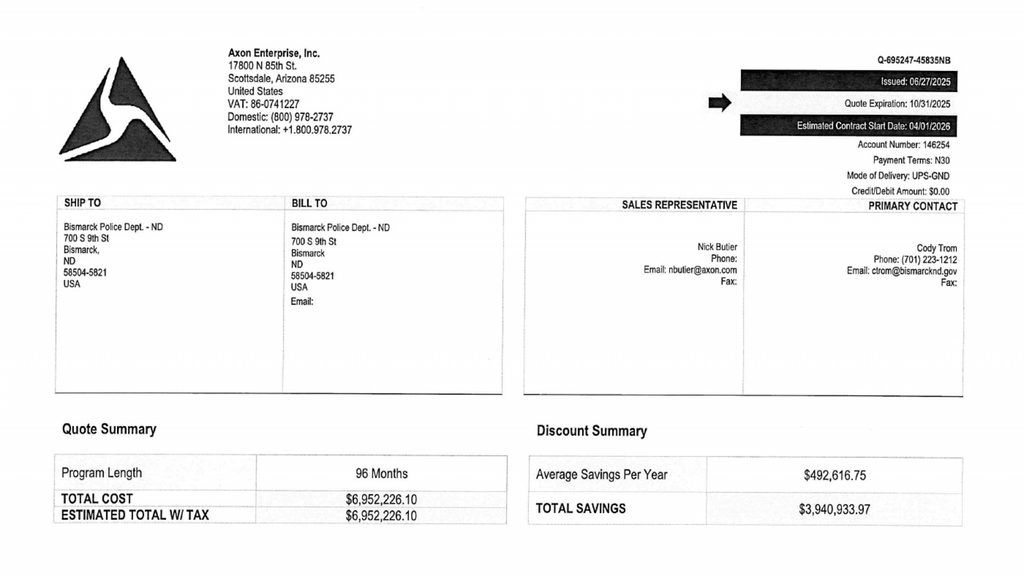
Records BPD provided to 701 Report show a quote the department signed with Axon on June 27, 2025, for a 96-month program starting April 1, 2026. It covers body-worn cameras, in-car cameras, TASER devices, drone and video software, and other equipment and services, not just surveillance gear. The quote’s total is $6,952,226.10, paid in eight annual installments that start at $755,272.89 in March 2026 and rise to $992,761.51 in March 2033. It says it replaces BPD’s earlier Axon contracts as of April 1, 2026. The work is governed by a master agreement the city signed with Axon on March 31, 2023.
The license plate readers in BPD’s cruisers are a small part of that package. The quote lists 45 Fleet 3 plate reader licenses at $0.00 each, which matches Stugelmeyer’s account that they came at no separate cost. Lt. Luke Gardiner, BPD’s public information officer, said the Axon data belongs to BPD and is searchable the same way as Flock, with a search reason required. The system as a whole is a budget line, not a free feature, and BPD’s written policy, General Order 4112, spells out how it is supposed to be used.
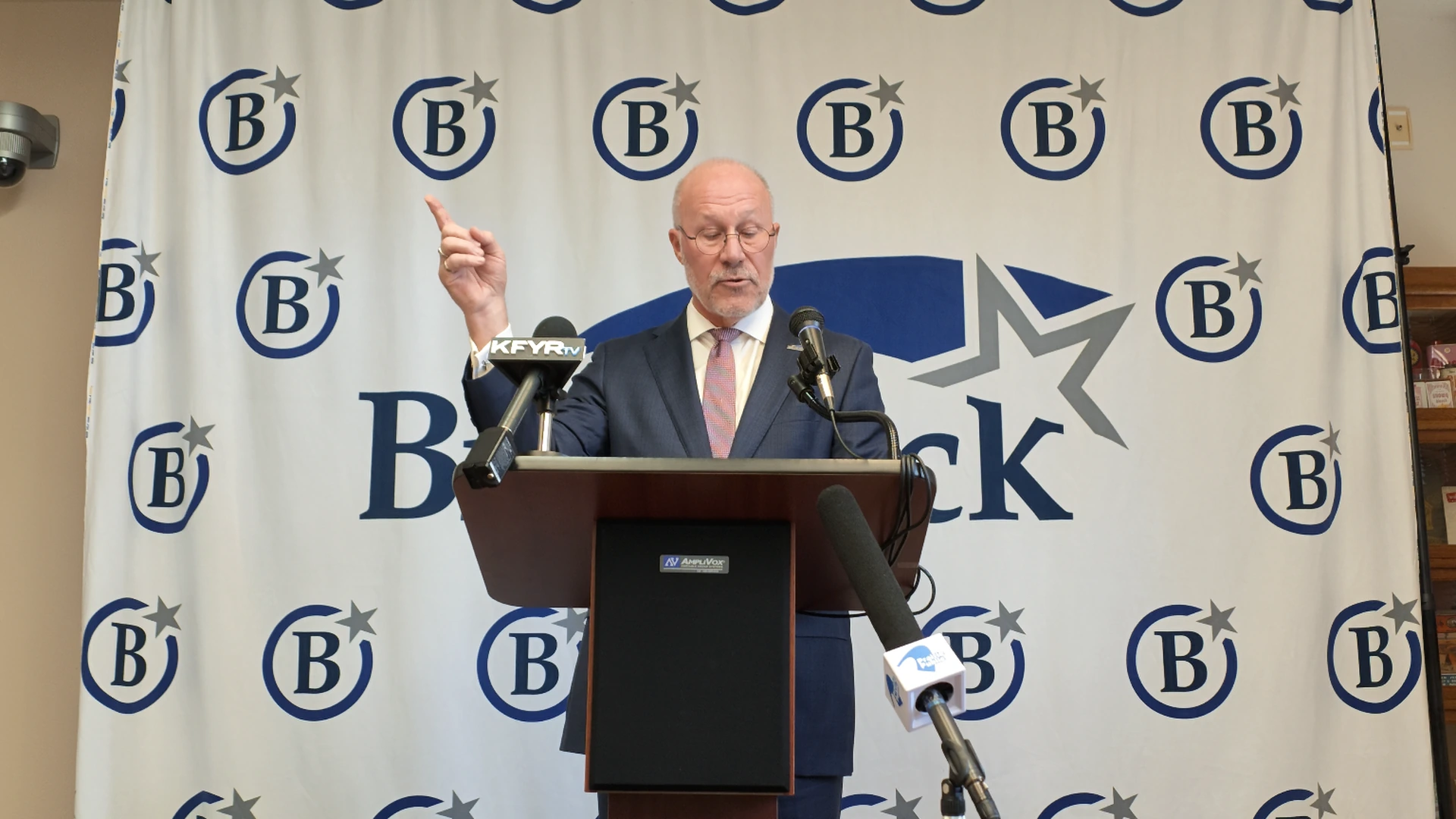
Stugelmeyer told 701 Report BPD has paused any expansion and has no plans to add fixed cameras right now, and that he wants to see what the legislature does. He also said residents who object to this technology can petition their government. The master agreement says payment obligations are non-cancelable, but allows the city to terminate if funds are not appropriated to pay the fees. Those spending decisions go through the City Commission, which meets in public.
If you want to change how Bismarck uses this technology, cutting down cameras isn’t the way. It could land you a felony, and it wouldn’t touch BPD, which doesn’t own the Flock cameras and pays nothing for them. Follow the money instead. BPD’s Axon contract is a public expense, and spending decisions go through the City Commission, which meets in public. Meetings are posted online by Dakota Media Access. Show up, ask questions, and tell your city leaders what you think.
701 Report will keep reporting on how these systems are used in Bismarck.

Leave a Reply